What is Comprehension?
- Researchers describe comprehension as the “bottom line” of reading and all the skills it takes to become a successful reader.
- To understand comprehension, it is important to know the processes that come before a reader reaches the point of understanding what they are reading. Basically this means you don’t just learn to comprehend.
- Research was done by many disciplines, and the “Simple View of Reading” was developed. This concept explains how any deficits in reading skills can impair the ability to read.
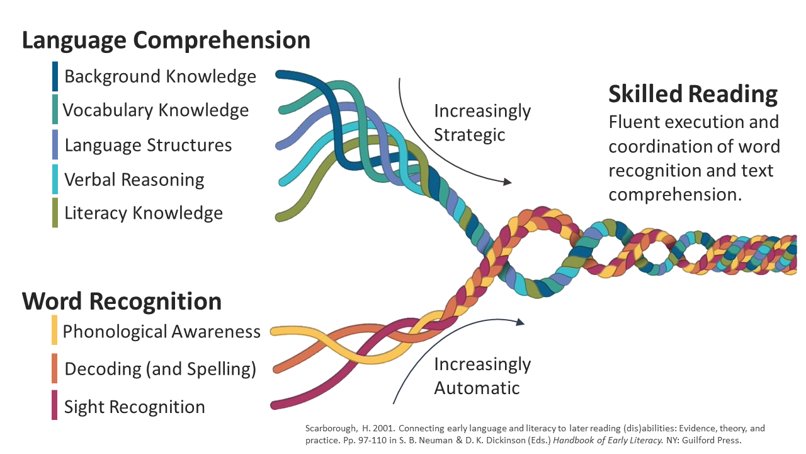
Here is a good visual of the Simple View of Reading and Scarborough’s Reading Rope:

You must have whole parts to equal reading comprehension. So if Joey has only part of word recognition (.5) and a 1 for Language comprehension, that is not enough to reach a level of reading comprehension because .5 x 1 = .5
Scarborough’s Rope is described as “The Many Strands that are Woven into Skilled Reading”
- The Reading Rope consists of lower and upper strands.
- The word-recognition strands (phonological awareness, decoding, and sight recognition of familiar words) work together as the reader becomes accurate, fluent, and increasingly automatic with repetition and practice.
- The language-comprehension strands (background knowledge, vocabulary, language structures, verbal reasoning, and literacy knowledge) reinforce one another and then weave together with the word-recognition strands to produce a skilled reader.
- This does not happen overnight; it requires instruction and practice over time.
Teaching Comprehension:
Teaching Comprehension is to Teach Strategies:
- Think Aloud– thinking aloud is asking oneself to use critical thinking to understand important concepts.
- Set Goals– by setting goals readers tend to choose what to focus on and this is important because it gives the reader a target in their reading purpose.
- Make Connections– making connections is important because the reader can make prior knowledge connections to better understand the text they are reading.
- Selective– readers who are selective tend to focus on the important part of the text. This strategy is important because it places the reader in control of deciding whether they need to read certain parts of text for better understanding or not.
- Making inferences- The ability to think “outside of the text” is important for the reader to be thinking in higher level thinking skills and can make applications to the real world.
Activities to Practice the Skills/Strategies of Comprehension:
- Before Reading- motivate students, activate prior knowledge, look at text structure, and set a purpose. Example: Motivate students by making the text relevant- possibly a book talk.
- During Reading– Teach students how to self monitor, use graphic organizers, use visualization, utilize cooperative learning and reciprocal teaching, and teaching purposeful questioning. Example: A Student can create a graphic organizer as they progress through the reading and can include pictures (visualization).
- After Reading– activities that connect back to purpose, creative discussion, create your own quiz, write a reader’s theater and perform, compare pros and cons, write a summary using academic vocabulary, complete an outline or graphic organizer. Example: Have student write a quiz that includes different types of questions ( implied, inferred, explicit…etc).
Assessing Comprehension:
- Oral Narrative Retell- Qualitative analysis of comprehension- Oral retelling is an informal assessment and looks for detail and structure and coherence of content to reflect the level of comprehension.
- Qualitative Reading Inventory(QRI) – this is a comprehensive assessment that can be used through high school. The QRI assessment assesses word identification, oral reading, oral retelling, and comprehension questions that range from general to inferring.
- Cloze and Maze Assessments: Cloze assessments delete words from the passage and the student uses the context clues to determine which word fits best. Maze assessments use multiple choice selections for determining which word fits best in the context of the sentence.